 DeskPulse
Crypto Fear & Greed index explained
The Fear & Greed index compresses the mood of the crypto market into one number from 0 to 100. Here is what goes into it, how people use it, and the easiest way to keep it in view.
What the index measures
The Crypto Fear & Greed index, published daily by alternative.me, combines several market signals into a single score:
- Volatility — unusually large moves push the score toward fear.
- Momentum and volume — strong buying volume in an uptrend reads as greed.
- Social media — activity and sentiment around major coins.
- Bitcoin dominance — a rising BTC share of the market is often read as a flight to safety.
- Search trends — spikes in searches for crypto terms.
The result is a number and a label:
| Score | Label | Typical reading |
|---|---|---|
| 0–24 | Extreme fear | Panic selling, capitulation |
| 25–44 | Fear | Cautious, defensive |
| 45–55 | Neutral | No strong bias |
| 56–75 | Greed | Optimism, rising leverage |
| 76–100 | Extreme greed | Euphoria, FOMO |
How people use it
The index is a contrarian sentiment gauge, not a prediction. The common reading is Warren Buffett’s line turned into a dial: extreme fear can mark moments when others are over-selling, and extreme greed can mark moments when the market is over-extended. Most people use it as context for a decision they were already considering — a reason to slow down when the dial is pinned at greed, or to look more closely when it is pinned at fear — rather than as a signal on its own.
What it is not
It is a daily snapshot of Bitcoin-centric sentiment. It does not know about your altcoin, it lags fast moves, and it has stayed in “extreme greed” for weeks during strong bull runs. Treat it as a weather report, not a forecast.
Keeping it on your desktop
Checking a website for one number gets old. DeskPulse, a free crypto widget for Windows, shows the current Fear & Greed score and label at the top of the widget next to BTC dominance and total market cap, refreshed automatically.
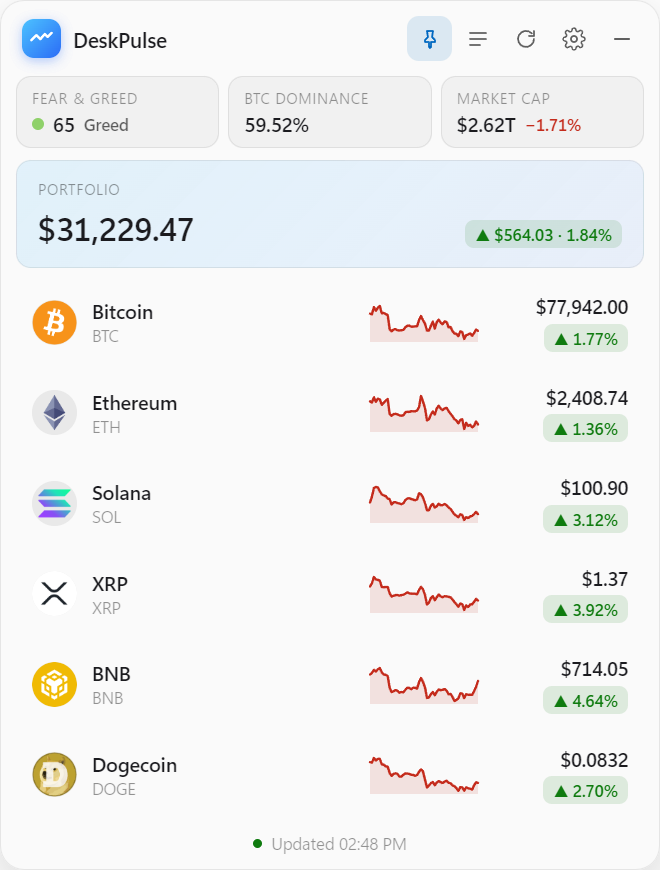
Data credit: the index is produced by alternative.me. Market data in DeskPulse comes from CoinGecko.